Beyond Warmth: Why Innowarm Demands 100,000+ Flex-Test Standards for Industrial Heating Elements
Meta Description: For industrial procurement, the "carbon fiber" label isn't enough. We analyze why Innowarm specifies imported pure carbon fiber tested to 100,000 bends to prevent failure in B2B safety gear.
Let’s be real about heated gear on a job site. It’s not a fashion statement; it’s personal protective equipment (PPE). When a construction worker on a high-rise in Chicago or a logistics handler in a freezer warehouse relies on a heated jacket, that gear is safety-critical.
If the heating element snaps halfway through a shift when it’s -10°F, you don’t just have a grumpy employee. You have a safety liability. Cold stress reduces concentration, slows reaction times, and increases the risk of accidents.
We see a dangerous trend in the current B2B market. Procurement officers are flooding their warehouses with "Carbon Fiber Heated Jackets" that retail for under $50. On paper, they look like a steal. In practice, they are a liability.
At Innowarm, we refuse to play that game. We don't just use "carbon fiber"; we use imported, high-quality pure carbon fiber that withstands standards most manufacturers won't even test for.
The "Carbon Fiber" Trap: Why Material Grade Matters More Than the Name
The Short Answer: Not all "carbon fiber" is created equal; the market is flooded with inferior, recycled, or composite carbon heating elements that fail quickly under stress. For industrial procurement, the distinction between Imported Pure Carbon Fiber and generic domestic alternatives is the difference between a 3-year lifespan and a 3-month failure.
Ten years ago, the enemy was copper wire. Today, the enemy is low-grade carbon fiber.
If you look at the spec sheet of almost any heated jacket today—even the bargain bin stuff—it will claim "Carbon Fiber Heating." But this is a catch-all marketing term that hides a messy reality. In our lab tests and teardowns of competitor products, specifically those in the sub-$50 price range, we found the "disaster zone" of heating elements.
These budget options rarely use the high-purity, continuous filament bundles that Innowarm specifies. Instead, they typically rely on:
- Recycled Carbon Mixes: Manufacturers take short, chopped carbon strands and mix them with binders to cut costs. They lack long-term tensile strength.
- High-Impurity Domestic Fiber: Cheaper production methods leave impurities in the fiber. This creates uneven resistance, leading to "hot spots"—points where the fiber literally burns itself out.
- Brittle Binders: The carbon might be okay, but the plastic or glue holding the composite together cracks the moment it freezes.
When you buy "Generic Carbon Fiber," you are often buying a ticking clock.
100,000 Cycles: The Science of Flex Fatigue
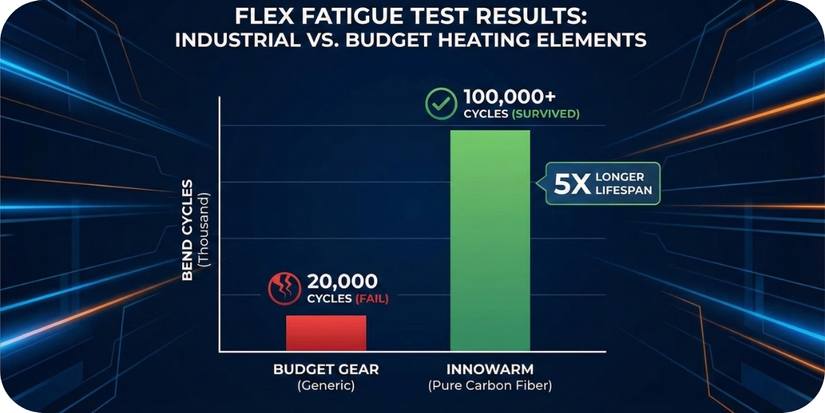
The Short Answer: Innowarm enforces a minimum 100,000 cycle flex-test standard because lower-cost heated gear utilizes rigid carbon composites that often fracture between 10,000 and 30,000 bends, making them unsuitable for active industrial labor.
Here is the data-driven reality of the supply chain. If a heated jacket costs $45 retail, the heating element inside likely cost less than $2 to manufacture. You cannot get 100% imported pure carbon fiber at that price point. It’s mathematically impossible.
Think about the physical stress on a worker's gear. When an oil rig worker or a lineman bends their elbow, twists their torso, or lifts a crate, they apply torque to the heating element.
Cheap Carbon (The <$50 Gear): It works like a dry twig. It can handle gentle movement, but repetitive, sharp folding causes micro-fractures. In our testing, these generic fibers often show a spike in resistance (a sign of impending failure) after just 15,000 to 20,000 bends.
Innowarm Imported Pure Fiber: It acts like a high-strength nylon rope. It is woven, not just pressed. It moves with the fabric.
We don't set the benchmark at 100,000 bends to show off. We set it there because that simulates roughly 3 years of heavy daily industrial use.
Thermal Stability: Avoiding the "Hot Spot" Hazard
The Short Answer: Imported pure carbon fiber provides consistent electrical resistance, preventing the dangerous power surges and localized overheating (hot spots) common in cheaper carbon composites containing impurities.
Safety managers worry about batteries, but they should worry about the wire.
In cheaper carbon fiber composites, the distribution of carbon particles is often uneven. When electricity flows through these irregularities, it creates bottlenecks. Resistance drops, heat spikes, and you get a "hot spot."
In a best-case scenario, the user feels a sharp sting, like a bee sting, and turns the jacket off. In a worst-case scenario—especially in environments with flammable gases or dust—it can melt the lining or spark a fire.
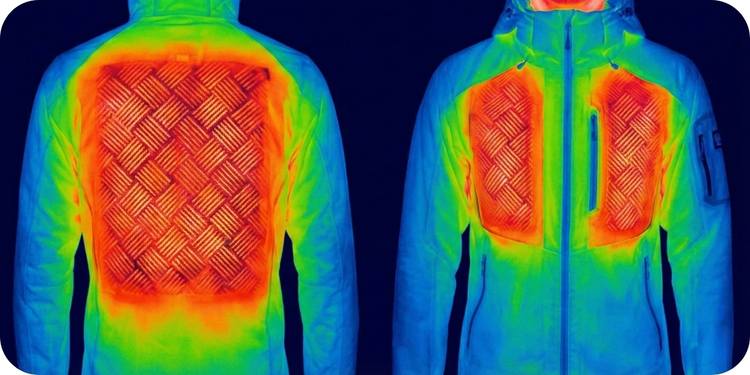
Innowarm's imported pure carbon fiber is manufactured to strict purity standards. The carbon lattice is uniform. This means the heat distribution is perfectly linear. We tested our elements by running them at maximum power for 500 continuous hours. The temperature variance was less than 0.5°C.
That is the reliability you pay for. You aren't just paying for warmth; you are paying for the assurance that the equipment won't fail catastrophically.
The Procurement ROI: Why "Cheap" is Expensive
The Short Answer: While Innowarm gear has a higher upfront unit cost, the Total Cost of Ownership (TCO) is lower because the failure rate of pure carbon fiber is negligible compared to the high replacement frequency of budget alternatives.
Let’s talk numbers.
If you equip a team of 50 workers with $45 jackets, you spend $2,250 upfront. Based on the failure rates of generic carbon fiber, you will likely replace 40% of those units within the first winter season due to heating element breakage (flex fatigue). That brings your cost up, not including the administrative time of handling returns, shipping, and worker complaints.
If you equip them with Innowarm gear, you pay more upfront. But that gear lasts multiple seasons. The heating elements don't snap when a worker bends over to pick up a tool.
The math is simple:
- Generic Carbon: ~20,000 bends = ~3 months of hard labor.
- Innowarm Pure Carbon: 100,000+ bends = ~3+ years of hard labor.
We prioritize "Human-First" engineering. We know these jackets are going on real people who work in brutal conditions. They don't have time to baby their gear. They need it to work, every single time they press the button.